Reading time: ~8 minutes | Last updated: May 2026 | Category: Verification & COA Literacy
How to Read a Peptide COA: What to Look For and Red Flags to Avoid
Research notice: This article is for informational and educational purposes only. Nothing here constitutes medical advice, dosing guidance, or treatment recommendations. Always source research compounds from verified vendors with documented third-party testing.
Why the COA Is the Most Important Document in the Research Peptide Space
If you're sourcing research peptides, the Certificate of Analysis — the COA — is the single most important document a vendor can provide. It's the difference between knowing what's in a vial and taking someone's word for it.
The problem is that most people don't know how to read one. Vendors know this. Some provide legitimate, detailed third-party COAs. Others hand out documents that look official but are essentially useless — missing critical data, self-issued, or recycled across batches. Knowing the difference isn't complicated once you know what to look for.
This guide breaks it down in plain language. No chemistry degree required.
What Is a Certificate of Analysis?
A COA is a document issued by a laboratory that confirms the identity, purity, and composition of a compound. For research peptides, it should verify:
- That the compound is what the vendor says it is (identity confirmation)
- How pure it is (purity percentage)
- That it's free from harmful contaminants (safety testing)
- The specific batch or lot number it applies to
A COA is only as trustworthy as the lab that issued it. A vendor can produce an in-house document that looks exactly like a legitimate COA — same format, same numbers — but carries zero independent verification. This is one of the most common quality-control failures in the research peptide market.
First Check: Is It Actually Third-Party?
Before you look at a single number on a COA, ask one question: who issued it?
A legitimate COA comes from an independent, accredited laboratory — not the vendor's own facility. Look for:
- A lab name and address that is separate from the vendor
- A lab that you can independently verify exists (Google them)
- Ideally, an ISO/IEC 17025 accredited facility — the international standard for testing labs
If the COA has the vendor's own branding, logo, or address on it as the issuing lab, treat it as unverified. It's not necessarily fraudulent — some vendors do internal testing as a starting point — but it provides no independent assurance of what's actually in the vial.
The vendors in the PROTOKOL X Trust Index are evaluated in part on whether their COAs come from verifiable, independent labs. It's one of the highest-weight signals in the ranking system.
Second Check: Does the Batch Number Match?
Every legitimate COA should include a batch or lot number — a unique identifier tied to a specific production run of a compound. When you order a product, the batch number on the vial (or on the product listing) should match the batch number on the COA.
If a vendor provides one COA for all orders of a compound, regardless of when it was produced or from which batch, that's a red flag. Purity and composition can vary between production runs. A COA that isn't batch-specific tells you almost nothing about what's in your specific vial.
Good vendors make it easy to match batch numbers. Some include a QR code on the vial that links directly to the relevant COA. That level of traceability is what you're looking for.
Understanding Purity: What HPLC Actually Means
The purity percentage on a COA — the number most people look at first — is almost always generated by HPLC: High-Performance Liquid Chromatography.
Here's how it works in plain terms: HPLC separates the components of a sample by pushing it through a column with a liquid solvent. Different molecules travel through the column at different speeds. The result is a chromatogram — a graph showing peaks that correspond to different compounds in the sample. The size of each peak represents the relative amount of that compound.
The purity percentage is calculated as the ratio of the target compound's peak to the total area of all peaks. A result of 98.5% purity means that 98.5% of what's in the vial (by area) is the intended peptide, with 1.5% being other compounds.
What to look for:
- ≥98% purity is the accepted benchmark for research-grade peptides
- The COA should include the actual chromatogram, not just the number — the graph is the evidence
- Look for the retention time of the target compound and confirmation that the main peak matches expected values
A COA that reports a purity percentage without including the underlying chromatogram data is providing a conclusion without the evidence. That's worth noting.
Identity Confirmation: Why Mass Spec Matters
HPLC tells you how pure a sample is. It doesn't definitively tell you what the main compound actually is. That's where mass spectrometry (MS) comes in.
Mass spectrometry measures the molecular weight of compounds in a sample. Every peptide has a known molecular weight. If the mass spec result matches the expected molecular weight of, say, BPC-157 (MW: 1419.53 Da), that's strong evidence the compound is what it's claimed to be.
HPLC + mass spec together is the gold standard for peptide verification:
- HPLC confirms purity (how much of the sample is the target compound)
- Mass spec confirms identity (that the target compound is actually what it's supposed to be)
Some vendors provide only HPLC. That's acceptable as a baseline. Vendors who provide both are offering a meaningfully higher level of verification — and it's reflected in how PROTOKOL X ranks them on the Trust Index.
Contaminant Testing: The Section Most People Skip
Purity and identity testing tell you about the peptide itself. Contaminant testing tells you about everything else that might be in the vial.
For research peptides, the key contaminants to look for testing on:
- Residual solvents — chemicals used in the synthesis process that should be removed. Common ones include acetonitrile, TFA (trifluoroacetic acid), and DMF.
- Heavy metals — lead, arsenic, mercury, cadmium. Not always tested, but premium vendors include it.
- Microbial contamination — bacterial endotoxins (LAL testing) and sterility testing are critical for any compound intended for research use. This is especially important for injectable research applications.
Not every COA will cover all of these. Residual solvent and endotoxin testing are the most commonly provided. If a vendor provides none of this — only purity — that's a gap worth noting when evaluating their documentation quality.
COA Red Flags: What Should Make You Stop
Having spent significant time vetting vendors for PROTOKOL X, these are the patterns that consistently signal a documentation problem:
1. No COA at All
Surprisingly common among lower-tier vendors. If a vendor can't or won't provide a COA, there's no basis for evaluating what they're selling. Move on.
2. One COA for All Batches
A single undated or non-batch-specific COA applied to all products or all orders of a compound. This document may be legitimate for the batch it was created for — but it tells you nothing about what you're actually receiving.
3. Self-Issued Documentation
The vendor is both the seller and the lab on the COA. No independent verification. This is the research peptide equivalent of a restaurant grading its own health inspection.
4. Missing Chromatogram
A purity percentage with no underlying HPLC chromatogram attached. The number could be accurate — or it could be fabricated. Without the graph, there's no way to assess the claim.
5. Suspiciously Round Numbers
Real HPLC results don't come out as exactly 99.0% or 98.0%. They come out as 98.7%, 99.2%, 97.4%. Perfectly round purity figures on a COA are worth scrutinizing.
6. No Lab Contact Information
Legitimate labs have contact information on their documentation. If the issuing lab on a COA is unlisted, unverifiable, or returns no results when you search for it, treat the document as unverified.
7. Undated or Stale Testing
COAs should be recent and batch-specific. A COA dated two or three years ago for a "current" product tells you nothing about what's in the vial today.
PROTOKOL X Verification Reference
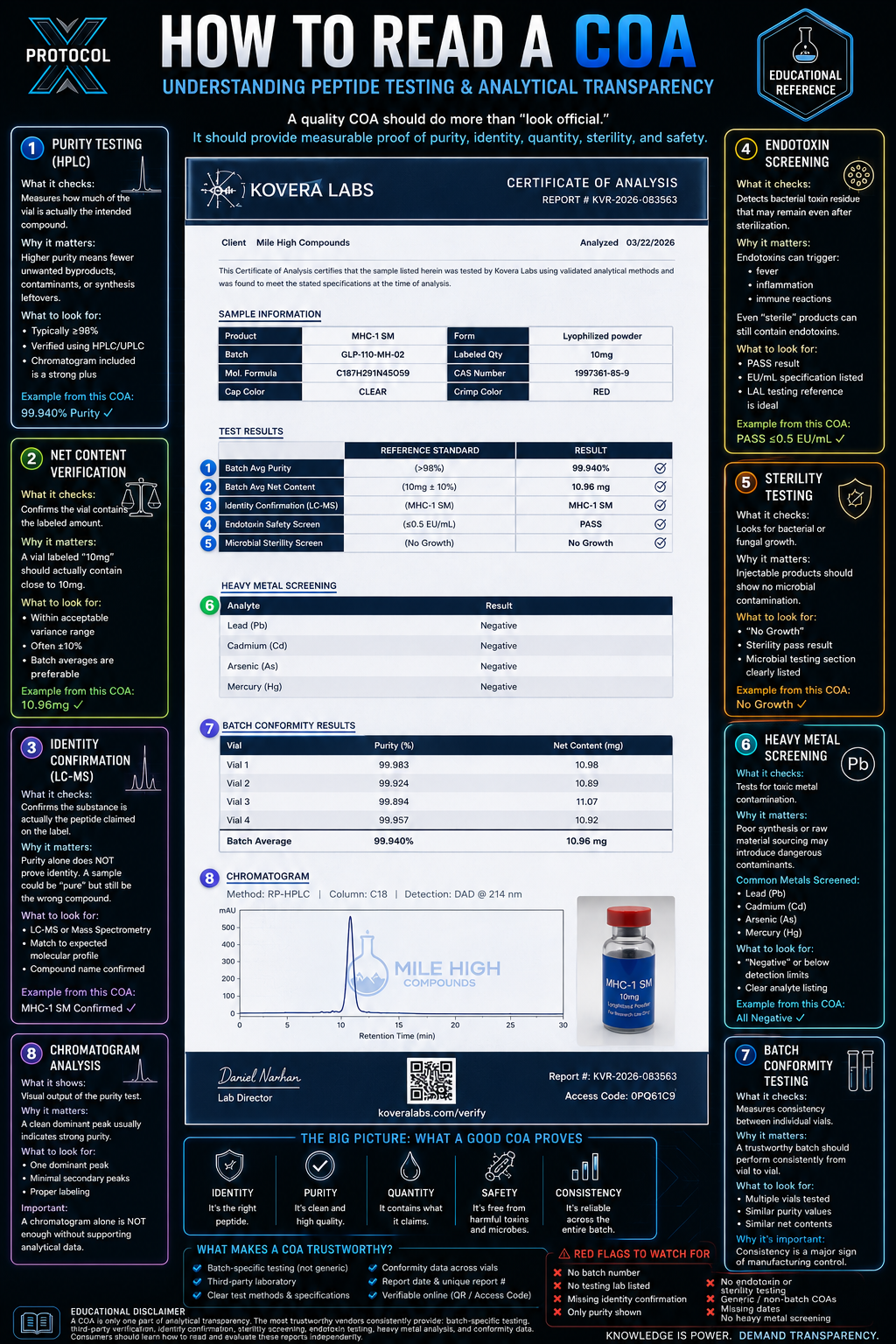
Use this visual reference as a quick checklist when reviewing peptide COAs. It summarizes the core validation signals and common documentation red flags covered above.
Using COA Quality to Evaluate Vendors
COA documentation quality is one of the clearest signals of a vendor's overall operational standards. A vendor who invests in rigorous, batch-specific, third-party testing is making a significant ongoing commitment to transparency. That commitment tends to correlate with quality across the board.
The PROTOKOL X Vendor Trust Index uses COA access and testing quality as a primary ranking signal. Vendors like ION Peptide and SwissChems earn their Tier 1 placement in part because their documentation practices are consistently above the baseline.
If you're comparing vendors and want a framework for evaluation, the Trust Index methodology page breaks down exactly what signals are weighted and why.
Tools for Your Research on PROTOKOL X
Once you've verified a compound's documentation and you're ready to plan a research protocol, two tools on this site are worth having open:
Peptide Calculator — handles reconstitution math: bacteriostatic water volumes, concentration targets, and syringe measurements. Takes the guesswork out of preparation.
Protocol Tracker — log your research protocol, track supply levels, record notes, and export your data as JSON. Built for organized, documented research from your phone.
Frequently Asked Questions
What does COA stand for?
Certificate of Analysis. It's a document issued by a laboratory confirming the identity, purity, and composition of a compound.
What purity percentage should a research peptide COA show?
≥98% purity via HPLC is the accepted benchmark for research-grade material. Some premium vendors provide results of 99%+.
What is the difference between HPLC and mass spectrometry on a COA?
HPLC measures purity — what percentage of the sample is the target compound. Mass spectrometry confirms identity — that the compound is actually what it's claimed to be. Together they form the gold standard for peptide verification.
Can I trust a COA issued by the vendor themselves?
Self-issued COAs provide no independent verification. They may be accurate, but there's no way to confirm that. Always look for COAs from a named, verifiable third-party laboratory.
What is endotoxin testing and why does it matter?
Endotoxins are bacterial byproducts that can remain in a compound after synthesis. LAL (Limulus Amebocyte Lysate) testing checks for their presence. For research use, endotoxin levels matter because they can interfere with experimental results and affect biological responses independent of the peptide itself.
Where can I find vendors with strong COA documentation?
The PROTOKOL X Trust Index ranks vendors based on COA quality, third-party testing practices, and overall documentation transparency.
The Bottom Line
A COA isn't just paperwork — it's the primary evidence that a vendor is selling what they claim to be selling. Knowing how to read one, and knowing what's missing when a document comes up short, is the foundation of responsible research peptide sourcing.
The checklist is straightforward: third-party lab, batch-specific, HPLC with chromatogram, mass spec for identity, contaminant testing where available. Any vendor operating at a serious level should be able to provide all of this without hesitation.
Use the Trust Index as a starting point for vendors who've already passed this bar, and the Calculator and Tracker to keep your research organized once you're ready to move forward.